The conversation around AI infrastructure has shifted. It is no longer a question of whether enterprises will need dedicated compute capacity. It is a question of whether they will be able to secure it in time.
The infrastructure market is telling a clear story. Capacity is constrained, lead times are long, and the organizations absorbing the available supply are not the mid-market AI operators and regulated industry enterprises that need it most.
The Compute Demand Curve Is Outpacing Available Capacity
Enterprise AI adoption is not slowing. Training workloads are scaling. Inference workloads, the operational layer that runs deployed AI models in production, are generating sustained, high-density compute demand that is categorically different from traditional enterprise IT loads.
H100 and H200 GPU clusters require rack power densities in the range of 80 to 120 kilowatts per rack. Traditional data center infrastructure, designed around 5 to 15 kilowatt per rack averages, cannot accommodate this load without substantial retrofitting. Multi-tenant colocation facilities are generally not built for it.
The result is a supply-demand mismatch that is structural, not cyclical. Hyperscale providers have absorbed the large-footprint capacity. Cloud providers are backlogged. And mid-market enterprises, organizations with between 50 and 5,000 employees running serious AI programs, are caught between cloud costs that do not scale and colocation options that cannot support the density their workloads require.
This is not a short-term bottleneck. It is the defining infrastructure constraint of the current AI build-out cycle.
Why Shared Multi-Tenant Infrastructure Cannot Serve Enterprise AI
The limitations of shared multi-tenant infrastructure for enterprise AI are technical, operational, and commercial.
On the technical side: multi-tenant facilities optimize for average density. Their power and cooling systems are designed to serve a distribution of tenants with varying workload profiles. GPU-intensive AI workloads are not average. They generate sustained thermal loads that shared cooling infrastructure was not built to handle efficiently. Power utilization effectiveness, or PUE, suffers. Thermal throttling becomes a performance variable. And the physical proximity constraints of shared environments introduce latency and bandwidth limitations that compound at scale.
On the operational side: shared infrastructure means shared failure domains. A configuration change, a cooling anomaly, or a power event in a neighboring tenant's environment can propagate. For training workloads that run for days or weeks and cannot be interrupted without losing progress, this is not an acceptable risk profile.
On the commercial side: the economics of shared colocation are misaligned with GPU infrastructure at scale. Cloud GPU rental carries a per-hour cost structure that becomes economically unsustainable once workloads exceed episodic use. At sustained training or inference volumes, the cost delta between cloud GPU rental and dedicated colocation is not marginal. It is the difference between a capital-efficient infrastructure strategy and one that is structurally unprofitable.
The Compliance Constraint That Changes the Calculus
For a specific class of enterprise AI operator, the shared infrastructure question is not primarily technical or economic. It is a compliance issue.
Healthcare organizations operating under HIPAA cannot run AI workloads against patient data in environments where physical infrastructure is shared with unknown third parties. HHS's January 2025 proposed update to the HIPAA Security Rule explicitly establishes that electronic protected health information used in AI training data, prediction models, and algorithm data maintained by a regulated entity is protected by HIPAA. The data residency and access control requirements that follow are not satisfied by shared colocation environments.
Financial services firms subject to SEC disclosure frameworks, SOC 2 attestation requirements, and fintech data residency rules face equivalent constraints. The question is not whether they prefer dedicated infrastructure. The question is whether their compliance posture permits anything else.
Defense contractors, sovereign AI operators, and enterprises with IP protection obligations face similar requirements. Data sovereignty is not a preference. It is a structural requirement that eliminates shared infrastructure as an option.
Single-tenant architecture, dedicated physical infrastructure with no shared components between clients, is the only configuration that satisfies these requirements by design, not by exception.
What Dedicated AI Infrastructure Actually Delivers
Dedicated AI infrastructure, built specifically for GPU density and operated as a single-tenant environment, addresses each of these constraints simultaneously.
On thermal efficiency: immersion cooling, the process of submerging compute hardware in dielectric fluid, removes heat at the point of generation with substantially greater efficiency than air-cooled systems. This enables rack densities in excess of 100 kilowatts that air-cooled environments cannot support. PUE scores for immersion-cooled facilities consistently outperform air-cooled alternatives, reducing the energy overhead of every compute cycle.
On operational stability: a single-tenant facility has no shared failure domains between clients. Power infrastructure, cooling systems, network architecture, and physical security are dedicated. The operational profile of one tenant cannot affect another because there is no shared infrastructure to propagate through.
On capital efficiency: at sustained compute volumes, dedicated colocation eliminates the per-hour variable cost structure of cloud GPU rental and replaces it with predictable, capacity-based pricing. For organizations running persistent inference workloads or extended training programs, this changes the unit economics of AI infrastructure in a material way.
On compliance: single-tenant architecture provides complete data sovereignty by design. Physical isolation is the baseline architecture. Compliance certifications, access controls, and data residency requirements are satisfied at the infrastructure level, not through contractual overlays applied to shared environments.
Understanding the Infrastructure Stack: What Dedicated Actually Means
When operators and infrastructure buyers use the term "dedicated AI infrastructure," the definition matters. The architecture decisions embedded in that term determine what is actually being purchased.
A single-tenant data center facility is one in which the physical infrastructure, power delivery, cooling systems, network interconnects, physical security, and the building envelope itself, serves one client exclusively. There are no neighboring tenants sharing a power distribution unit, no shared cooling loops, no network segments that carry traffic from multiple organizations.
This is distinct from dedicated hardware within a multi-tenant facility, which is a configuration available from many cloud and colocation providers. In that model, physical servers may be allocated to a single client, but the power and cooling infrastructure, the network backbone, and the physical premises remain shared. For compliance purposes, this distinction is not semantic. Regulatory frameworks that require physical data sovereignty are not satisfied by dedicated hardware in a shared facility.
It is also distinct from cloud GPU instances, whether dedicated or shared. Cloud infrastructure, regardless of configuration, routes compute through shared management planes, shared network fabrics, and shared physical facilities. For regulated industries, this architecture cannot be configured to meet the requirements. The shared infrastructure layer cannot be removed from the model.
Single-tenant immersion-cooled GPU infrastructure sits at a specific point in the infrastructure landscape: it provides the performance characteristics of on-premises hardware deployment, density, control, compliance, with the operational profile of managed colocation, including redundant power, physical security, and facilities management handled by the infrastructure operator.
The Market Window Is Narrowing
The 24-to-36-month lead time for new data center capacity is not an abstract planning figure. It is the constraint that determines whether an enterprise AI program can access the infrastructure it needs in the next planning cycle, or must wait for the one after that.
Organizations that begin the infrastructure evaluation process now will be positioned to access capacity as new supply comes online. Organizations that wait until AI program scale demands dedicated infrastructure will find themselves competing for constrained supply in an undersupplied market with a multi-year lead time.
The case for dedicated AI infrastructure in 2026 is not a forward-looking bet on where the market is going. It is a present-tense assessment of where the market already is: capacity-constrained, compliance-demanding, and structurally undersupplied for the enterprise AI workloads that require reliable, high-density, sovereign compute at scale.
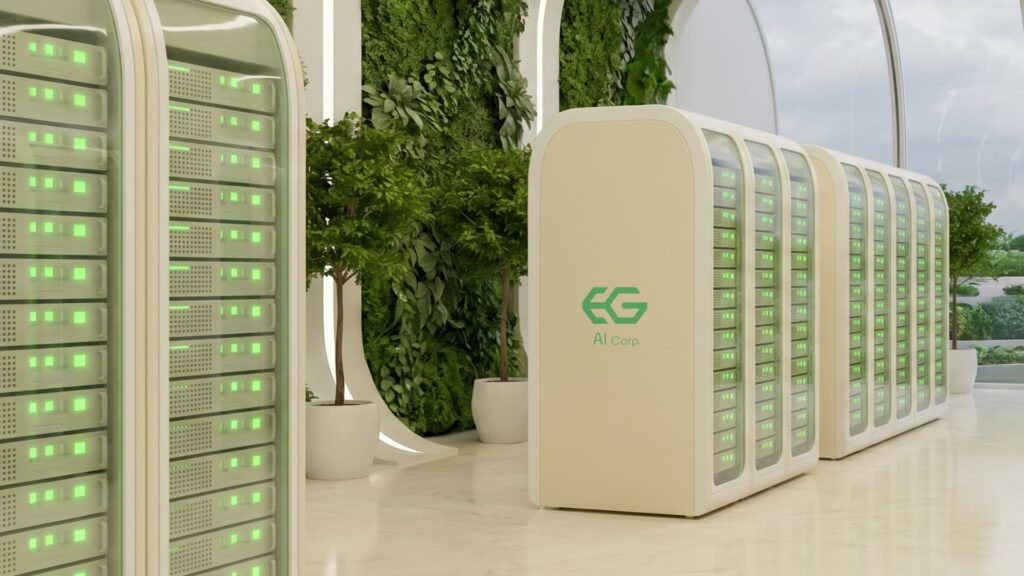
EG AI Corp is building single-tenant, immersion-cooled GPU infrastructure in Dallas, Texas, for the enterprise AI operators and regulated industry clients that the existing market is not serving. The facility is targeted for completion in 2027.
Sources: CBRE Research, North America Data Center Trends, H2 2025. CreditSights, Hyperscaler Capex 2026 Estimates. HHS/OCR, Notice of Proposed Rulemaking, HIPAA Security Rule Update, January 6, 2025. ERCOT Long-Term Load Forecast.