HIPAA AI infrastructure describes an operational state, not a product category. It depends on how AI systems access, process, and store electronic protected health information, not on which vendor's name is on the platform.
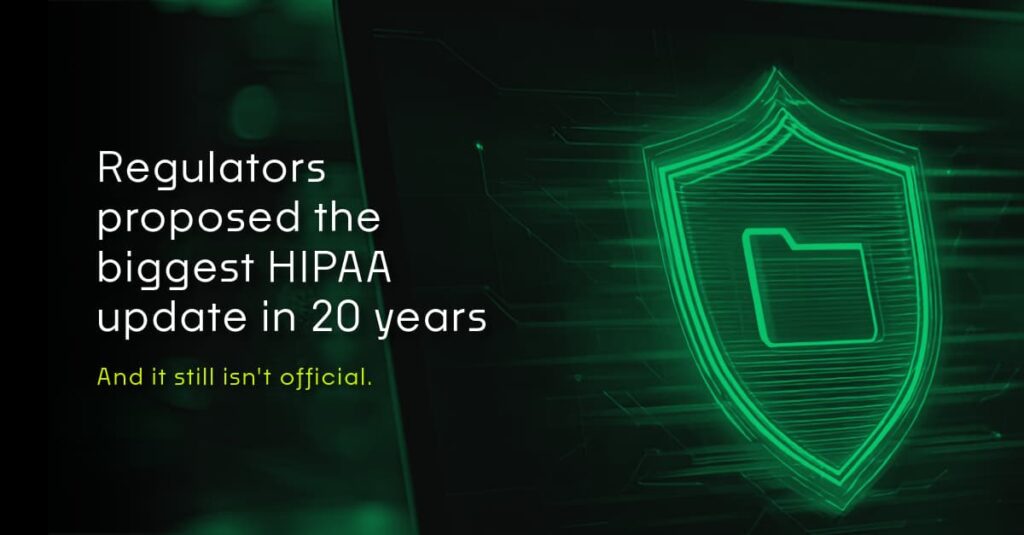
That distinction carries more weight heading into 2026. HHS has proposed the most significant Security Rule update in over two decades: mandatory encryption at rest and in transit, required multi-factor authentication for every system touching PHI, and a documented AI tool inventory. The proposal is not final. Its spring 2026 target passed without a rule, and HHS is still reviewing more than 4,700 public comments. Until a final rule publishes, the current Security Rule remains in force.
Enforcement has not waited on rulemaking. OCR resolved 21 settlements and civil monetary penalties in 2025, the second-highest annual total on record, collecting more than $8 million, with incomplete risk analysis a common thread across the majority of those actions. For healthcare CTOs, fintech compliance officers, and infrastructure buyers, where a regulated AI workload runs is already a compliance decision with audit and financial consequences, not a future one.
The Compliance Problem Multi-Tenant Infrastructure Creates for AI Workloads
Multi-tenant infrastructure serves multiple customers on shared hardware with logical isolation enforced through virtualization or containerization. That model delivers cost efficiency for general-purpose compute. For AI workloads touching protected health or regulated financial data, it introduces exposure that logical controls alone cannot fully resolve: data from multiple tenants traverses the same physical hardware, memory, and network pathways. Isolation stops one tenant from directly reading another's data, but it does not eliminate side-channel risk, does not guarantee a co-tenant's incident stays contained, and does not simplify the audit trail a compliance officer needs during an OCR review.
Risk analysis failures remain the single most cited violation in OCR's enforcement record, the exact control most frequently weakened when AI systems land on shared hardware without an updated risk assessment. Healthcare breaches stay the costliest of any sector at $7.42 million per incident in 2025 (IBM Cost of a Data Breach Report), even after a decline from $9.77 million the year before. The compliance premium on dedicated infrastructure is a fraction of that figure.
What HIPAA AI Infrastructure Actually Requires in 2026
HIPAA compliance is not a vendor certification; it depends on how AI is deployed, configured, documented, and monitored. No AI platform is HIPAA-compliant by default. Compliance depends on the infrastructure surrounding the model, the contractual agreements governing data handling, and the controls enforced at every layer of the stack.
Under the current Security Rule, encryption and several other safeguards remain classified as addressable, meaning an organization can adopt an equivalent alternative or document why a control does not fit its environment. HHS has proposed removing that flexibility, and OCR's enforcement pattern already treats these as baseline expectations regardless of the rule's final status. Waiting for a final rule to close these gaps treats a requirement as optional when regulators already do not.
For enterprise buyers, this means specific demands today: a Business Associate Agreement that explicitly covers AI inference, not just storage; customer-managed encryption keys, since provider-managed keys on shared infrastructure introduce a trust dependency compliance officers cannot independently verify; access controls that enforce the HIPAA minimum necessary standard at the operation level, so an agent processing clinical summaries does not carry the same data access as one handling scheduling; and an audit trail that can survive an OCR review. Multi-tenant environments can be configured to meet some of this, but complexity compounds with every layer added and every tenant boundary tested, showing up in engineering hours, compliance staff time, and the odds that one misconfiguration opens an exposure window.
Single-Tenant Data Center Compliance: How Physical Isolation Solves the Audit Problem
Single-tenant data center compliance runs on a different principle. When one organization occupies dedicated hardware, its own servers, its own network segment, its own storage, isolation becomes a physical property of the architecture rather than a software configuration that must be continuously verified.
That matters most during audits. Demonstrating compliance in a single-tenant environment is a simpler attestation exercise: the boundaries are visible and verifiable without asking an auditor to evaluate a provider's isolation mechanisms across every other customer on the platform. For AI workloads specifically, single-tenant infrastructure also removes the noisy neighbor problem. GPU-intensive inference and training are sensitive to resource contention; when a co-tenant's workload spikes on shared hardware, the impact spreads across the platform. In a dedicated environment, the organization controls the full compute allocation, thermal management, power delivery, and performance envelope, so consistency becomes a design property rather than a hope. That is why enterprises in heavily regulated sectors, healthcare under HIPAA, financial services under SOX and PCI-DSS, government under FedRAMP, increasingly favor single-tenant deployments once physical isolation becomes a compliance requirement rather than an efficiency preference.
Fintech AI Data Residency Requirements and the Infrastructure Decision
The compliance challenge extends beyond healthcare. PCI-DSS v4.0.1, fully mandatory since March 2025, requires that any system storing, processing, or transmitting cardholder data operate within an isolated Cardholder Data Environment, segmented from all non-payment systems with continuously enforced firewall rules and access controls. When an AI tool reads a support ticket containing payment information, that tool enters PCI scope. In a multi-tenant environment, proving the AI's data path never intersects with another tenant's cardholder environment requires continuous validation most organizations are not equipped to maintain.
SOC 2 Type II attestation, the baseline enterprise contract requirement for any fintech vendor, evaluates security controls over a six-to-twelve-month observation period. On shared infrastructure, the audit scope expands to include the provider's isolation mechanisms and incident response procedures across the whole environment. On dedicated infrastructure, it narrows to the organization's own controls within its own boundary. EU DORA adds a further layer for fintech firms with European operations: its incident reporting and third-party risk provisions require AI-related incident records to be retained and reproducible, and impose review requirements on every sub-processor in the data chain, something a vendor-hosted multi-tenant backend without a portable data export path struggles to satisfy. Across every framework here, the more sensitive the data, the more the compliance burden favors physical isolation over logical segmentation.
Why Dedicated AI Infrastructure for Regulated Industries Is an Engineering Requirement
The case for dedicated AI infrastructure in regulated industries follows from the operational reality of compliance at scale, not from vendor preference. AI governance has not kept pace with AI adoption: IBM's 2025 research found that a majority of organizations that adopted AI tools had no formal governance policy to manage the risk, and breaches involving AI systems occurred overwhelmingly at organizations lacking proper access controls. That gap is where breaches occur, enforcement follows, and remediation costs exceed the cost of proper infrastructure many times over.
Dedicated AI infrastructure does not remove compliance obligations; it simplifies them. A clear compute boundary makes the access control framework easier to enforce, the audit trail easier to produce, the risk assessment faster to document, and the breach response, if one occurs, contained within a defined perimeter rather than a shared environment requiring cooperation across multiple tenant organizations and their legal teams. For workloads that demand high GPU density, inference at scale, training on large models, real-time processing of clinical or financial data, dedicated infrastructure also delivers performance consistency that shared environments cannot guarantee, since thermal management, power delivery, and compute allocation stay under the organization's control.
How to Evaluate HIPAA AI Infrastructure Before You Sign
Enterprise buyers should apply a systematic framework before committing to any provider. Confirm the Business Associate Agreement covers the specific AI workloads planned, since a BAA covering cloud storage does not automatically extend to AI inference endpoints processing PHI. Verify the encryption architecture: customer-managed keys are the baseline for regulated workloads. Evaluate the audit trail by asking the provider to demonstrate inference-level logging, prompts, outputs, model versions, configuration parameters, isolated from other tenants' logs. Assess the incident response boundary: on dedicated infrastructure, the incident boundary matches the organization's own boundary, with no ambiguity about how a co-tenant's breach might affect your data or notification obligations. And request performance isolation documentation, since resource contention on GPU-intensive workloads degrades latency, affects model performance, and creates unpredictable cost variance that dedicated infrastructure removes.
The infrastructure decision functions as a compliance decision. Organizations that recognize this early avoid the remediation costs, enforcement exposure, and operational complexity that follow from choosing the wrong architecture for regulated AI workloads.
EG AI Corp is building single-tenant, immersion-cooled GPU infrastructure for enterprises that cannot compromise on data isolation, compliance integrity, or compute performance.