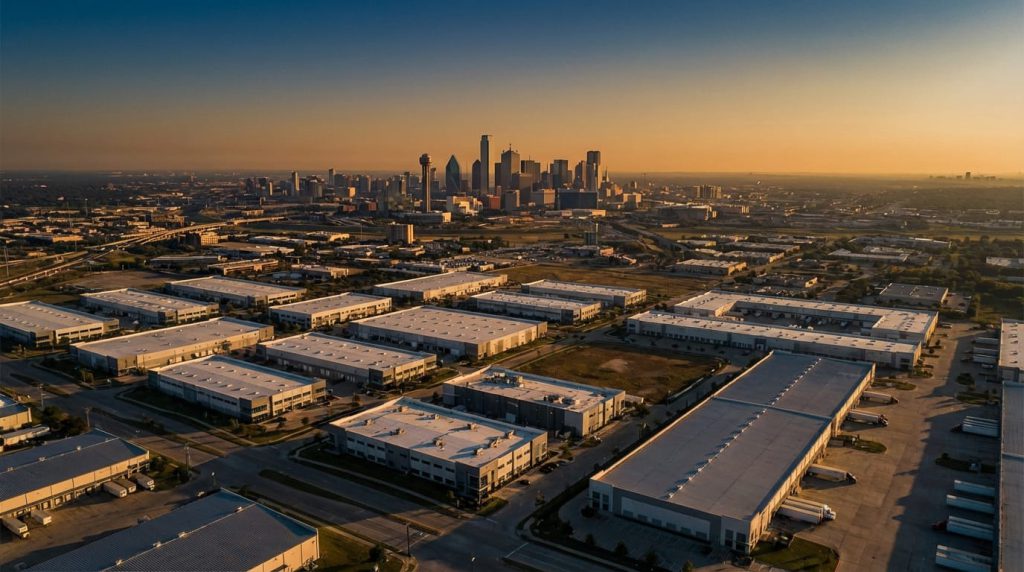
For the better part of two decades, the answer to "where should we build a data center" has been the same: Northern Virginia.
Ashburn, Loudoun County, the Dulles corridor — these names became synonymous with digital infrastructure the way Detroit once meant automobiles.
But that era of unquestioned dominance is winding down. The constraints that made NoVA great — dense fiber networks, proximity to federal agencies, early cloud adoption — have become the very factors limiting its future.
Grid capacity is stretched. Developable land is scarce. Permitting timelines have lengthened. And the market, as it always does, is adapting.
The adaptation has a clear geographic center: Texas.
According to JLL's year-end 2025 North America Data Center Outlook, Texas currently has 6.5 gigawatts of data center capacity under construction — enough to position the state to overtake Northern Virginia as the world's largest data center market by 2030.
That is not a marginal shift.
It represents a fundamental reordering of where America's compute infrastructure lives, and it is being driven by a convergence of factors that no other state can match in combination: abundant power generation, available land, favorable tax treatment, a deregulated energy market, and a permitting environment that moves at the speed of capital rather than the speed of bureaucracy.
The Numbers Behind the Migration
The scale of what is happening in Texas becomes clearer when you look at absorption and vacancy data. CBRE's H1 2025 market profile for Dallas-Fort Worth showed absorption of 575 megawatts — making DFW and Northern Virginia together responsible for roughly half of all nationwide data center absorption in the first half of the year.
Vacancy rates across North American data center markets have hit record lows, with CBRE reporting just 2.4 percent vacancy in the DFW market. Nationally, vacancy has been locked at approximately one percent for two consecutive years.
Rents climbed nine percent in 2025, consistent with a five-year compound annual growth rate of roughly ten percent.
These are not speculative projections. They describe a market where demand has already outrun supply and where planned construction capacity is being absorbed before buildings are finished.
In the Dallas-Fort Worth market specifically, 78 percent of planned construction capacity is already pre-leased. Vacancy rates have declined for two consecutive years even as new inventory has come online.
The market is expected to double in size by year-end 2026, and yet the overwhelming majority of that new capacity already has tenants committed.
That dynamic — record-high absorption paired with supply that cannot keep pace — has meaningful implications for anyone evaluating where to place compute infrastructure over the next three to five years.
Why Dallas, Specifically
Texas is a big state, and not all of it offers the same value proposition for data center operators. Austin, San Antonio, and Houston each have their own merits.
But Dallas-Fort Worth has emerged as the primary epicenter of the state's data center boom, and the reasons are structural rather than incidental.
Start with connectivity. The Infomart at 1950 North Stemmons Freeway is one of the densest interconnection hubs in the southern United States. More than 135 network providers maintain a physical presence in the building, with over 8,700 strands of fiber entering the facility.
Equinix, which acquired the Infomart in 2018 for $800 million, operates it as the largest internet exchange by participants and traffic volume in the south-central U.S.
That kind of connectivity density does not emerge overnight, and it cannot be easily replicated. It represents decades of incremental network investment that have made Dallas a natural routing center for traffic moving between the coasts.
Then there is power. The ERCOT grid — Texas's independent electrical grid — has more generation fuel in the form of solar, wind, and natural gas than any other region in the country.
Between 2024 and 2025, approximately 23 gigawatts of new generation capacity was added to the grid, with another nine gigawatts slated for early 2026.
ERCOT has also approved a $9.4 billion transmission expansion plan that includes building over a thousand miles of new 765-kilovolt "super highway" transmission lines.
The grid is not without its challenges — ERCOT's large-load interconnection queue has nearly quadrupled in a single year, and questions about reliability persist — but the raw generation capacity and the willingness to invest in infrastructure expansion set Texas apart from regions where utilities are struggling to keep pace with demand.
Land availability rounds out the picture. Dallas still offers large tracts of developable acreage at prices that remain competitive relative to established markets.
The south Dallas corridor in particular has attracted major campus-scale developments, including a 131-acre communications infrastructure campus by Lincoln Property Company and a 140-acre hyperscale campus by Stream Data Centers in Wilmer.
For operators looking to convert existing industrial properties — warehouses, distribution centers, light manufacturing facilities — into data center space, the Dallas market offers both inventory and pricing that make adaptive reuse economically viable in ways that Ashburn or Santa Clara cannot.
The Tax and Regulatory Equation
Texas has no state income tax. No corporate income tax, either.
That baseline advantage applies to every business in the state, but for data center operators — whose facilities generate relatively few jobs relative to the capital deployed — the absence of income tax is particularly significant.
Layered on top of that are data-center-specific incentives. Under House Bill 1223, qualifying data centers that invest at least $200 million, span 100,000 square feet or more, and create at least 20 jobs at above-average wages receive a full exemption from state sales tax on computing equipment, electrical infrastructure, cooling systems, power components, and software.
A 2023 update lowered the qualification threshold for operators building in economically distressed areas, reducing the minimum investment to $70 million and the job requirement to 10 positions.
Local governments can layer on property tax abatements of up to 10 years under Chapter 312 of the Texas Tax Code.
The regulatory environment matters, too, though perhaps not in the way people expect. Texas counties generally lack zoning authority, and a relatively recent state law allows developers to de-annex property from municipal jurisdictions.
The practical effect is that data center developers in Texas face fewer permitting hurdles and shorter approval timelines than their counterparts in markets where local opposition, environmental review, and zoning variance processes can add months or years to a project's timeline.
That speed advantage compounds quickly when capital costs are high and the market window for pre-leased capacity is narrow.
None of this means Texas is without friction. Some municipalities have begun pushing back on data center expansion, and the state's Public Utility Commission has floated the idea of requiring large AI data center operators to contribute to the power supply themselves.
The regulatory environment is evolving. But compared to markets where grid constraints have created de facto moratoriums on new large-load connections, Texas remains materially easier to build in.
What the Hyperscalers Are Signaling
The investment commitments from the largest players in the industry tell a story that is hard to misread.
OpenAI's Stargate project in Abilene launched its first two buildings in September 2025 with 1.2 gigawatts of capacity and plans to scale to five gigawatts across additional buildings by mid-2026.
Google announced plans to spend $40 billion in Texas over the next two years, including construction of two new data center campuses. Vantage Data Centers disclosed plans for a 1.4-gigawatt mega-campus in Shackelford County with a $25 billion investment.
These are not exploratory commitments. They are multi-billion-dollar bets on Texas as a long-term home for compute infrastructure, and they are being made by organizations with the resources and sophistication to evaluate every viable market in the world.
But the hyperscaler story, while dramatic, can obscure a more important dynamic.
The same market fundamentals that attract companies building gigawatt-scale campuses — reliable power, strong connectivity, favorable costs, available land — apply with equal or greater force to operators building at smaller scales.
A 2.5-megawatt facility benefits from Dallas's fiber density and ERCOT's generation capacity just as much as a 500-megawatt campus does.
The difference is that smaller operators can move faster, occupy adaptive-reuse properties that hyperscalers would never consider, and serve the mid-market customers that the largest providers are structurally unable to prioritize.
Supply, Demand, and the Mid-Market Gap
The data center industry's growth narrative tends to focus on the top of the market: the hyperscalers, the sovereign AI projects, the billion-dollar campus announcements.
That focus is understandable given the dollar figures involved.
But it creates a distorted picture of what is actually happening on the ground.
Despite record-high absorption in Texas in the first half of 2025, supply continues to lag behind demand. The vast majority of new construction is being built to suit for the largest tenants, pre-leased before the concrete is poured.
What is not being built, in Texas or anywhere else, is purpose-built private infrastructure for the companies that fall between the Fortune 500 and the startup tier — the mid-market businesses with 200 to 2,000 employees, real compliance requirements, sensitive data, and AI workloads that cannot live on shared public cloud infrastructure indefinitely.
This is the segment of the market where the disconnect between demand and available supply is most acute.
These companies are increasingly aware that their data and their AI models need to run on infrastructure they control, within U.S. jurisdiction, with the kind of compliance posture that public cloud providers cannot guarantee at the tenant level.
But the facilities that would serve them — smaller-footprint, compliance-ready, GPU-dense environments in well-connected markets — are not what the current construction boom is producing.
Dallas, with its combination of connectivity, power reliability, competitive real estate, and business-friendly operating environment, is arguably the best market in the country for addressing that gap.
The same warehouse properties that hyperscalers pass over — structures in the one-million-dollar range, sitting on sites with adequate power access and fiber proximity — are ideal candidates for conversion into private AI infrastructure serving the mid-market.
The economics of adaptive reuse in Dallas make it possible to deliver dedicated compute environments at price points that would be unthinkable in Northern Virginia or the Bay Area, without sacrificing the network performance or power reliability that enterprise workloads require.
The data center market is undergoing a geographic transformation that will play out over the rest of this decade. Texas is at the center of it, and Dallas is at the center of Texas.
For organizations making infrastructure decisions today — whether they are deploying AI models, repatriating workloads from public cloud, or building out private compute capacity for the first time — the location calculus has shifted.
The question is no longer whether Texas can compete with established markets. The question is whether the rest of the country can keep up.